
Decluttering by Selection: Home Organization
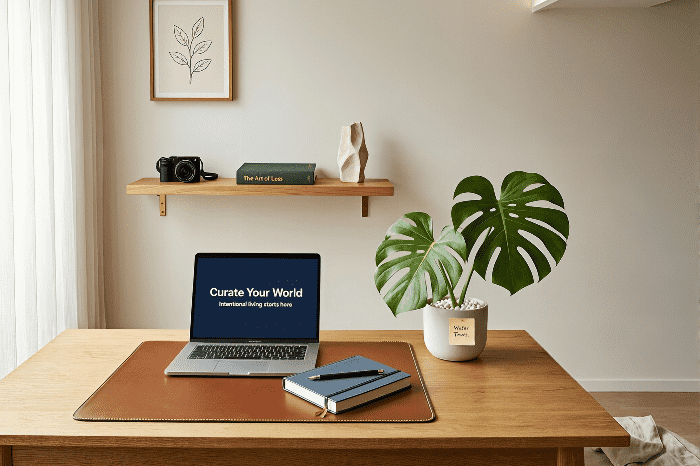
Structural Frameworks to Optimize Workspace Performance and Balance Interior Layouts
We’ve all been there. You sit down at your desk, ready to tackle the day, but your eyes keep darting to a random stack of mail, three half-empty coffee mugs, and a tangle of charging cords that looks like a bowl of electronic spaghetti. When your physical space resembles a chaotic free-for-all, it becomes challenging to enter the zone.
Most people tackle this problem by going on a frantic Sunday cleaning spree. They shove everything into plastic bins, hide the mess behind closet doors, and call it a day. But two weeks later? The clutter creeps right back.
That happens because cleaning and organizing are two entirely different animals. Cleaning hides the mess; curation fixes the system. When you approach your living space with the eye of a gallery curator, you stop managing junk and start building a home that actually supports how you live, work, and relax.
The Curation Mindset shifts from stuff to systems
 Think about a museum curator for a second. They don't throw every painting they own onto a single wall just because they have the space. They pick certain items that clearly tell a story, have a clear purpose, and give off a specific feel.
Curation in home organization works the exact same way. Instead of asking, "Where can I stash this?" you start asking, "Does this item deserve prime real estate in my daily life?"
When you curate, you treat your square footage like high-value land. Every item in your home should have a reason to stay — whether it’s useful, looks good, or makes you feel something. If an item doesn't hit at least one of those marks, it's just dead weight dragging down your space.
Mapping Your Space for High Performance
If you want a home workspace that supercharges your focus, you need to map out your layout based on how you actually move and work. Designers call this "zoning," but you can just think of it as building a low-friction environment. 
Zone 1: The Active Reach
This is the area that is easily accessible when you are seated at your desk. Keep only your absolute essentials here—your laptop, a notebook, a favorite pen, and a glass of water. If you don't touch an item multiple times a day, push it out of Zone 1.
Zone 2: The Secondary Orbit
This covers drawers, side tables, and shelves you can reach just by swiveling your chair or taking one step. Store items you use weekly or twice a day here, like extra chargers, reference books, or blue-light glasses.
Zone 3: The Archive
This is for tax documents, extra printer paper, and back-up office supplies. Stash these in closed storage, high shelves, or a closet. You don't need to look at them every day, so don't let them steal visual attention from your main work area.
Grouping your gear in this manner reduces the micro-distractions that frequently disrupt your train of thought. Your brain can finally relax because the environment feels logical and predictable.
Structural Frameworks That Actually Last
To make your new layout stay functional, you need solid frameworks that hold up when life gets busy. Here are three structural approaches that stop clutter before it starts.
 1. The "One-Touch" Flow
Try to process everyday items the first time you touch them. When you walk through the door with mail, don't drop it on the kitchen counter to "deal with later." Either shred it, file it, or pay the bill right then. Reducing the number of times you physically handle an object saves energy and keeps surfaces clear.
2. Visual Weight and Spatial Balance
A room can feel cluttered even when the floor is clean if the visual weight sits out of balance. Heavy, dark furniture crammed into one corner makes a room feel lopsided and cramped. Distribute your large pieces evenly, leave breathing room around sightlines, and use floating shelves to pull storage off the floor. Open space isn't wasted space; it is room for your visual field to breathe - a principle that is just as vital when creating a soothing bedroom environment as it is in your home office.
3. Container Boundaries
Don't buy storage containers until after you curate your belongings. Bins and boxes should act as strict boundaries, not junk drawers with lids. If your notebook collection overflows its designated basket, that is your cue to prune the collection—not to buy a bigger basket.
Blending Function with Interior Aesthetics
A high-performing space doesn't have to look like a cold, sterile laboratory. You want an environment that fuels your productivity while still feeling like a cozy home. 
Use Concealed vs. Open Storage Strategically: Hide the messy stuff—tangled cords, extra routers, random paper piles—inside closed cabinets or bins. Leave the open shelves just for things you actually like looking at, like your favorite books, a few plants, or nice objects.
Master Natural Lighting: Place your primary desk near a window, either facing the glass or perpendicular to it, to maximize natural light. This optimal positioning significantly reduces eye strain while visually expanding a compact workspace.
Add Tactile Materials: Use natural window light and add soft touch items like a woven rug or leather desk mat to counter hard desk surfaces and add a few of the best indoor plants for your workspace. These cozy pieces warm up the room and stop your workspace from feeling cold and clinical.
Keeping things steady as life changes
Organizing your home isn't a quick and simple project you finish in a weekend. It's an ongoing habit, a lightweight rhythm you build into your routine. Spend five minutes at the end of every workday resetting your desk back to its baseline. Put the caps back on pens, tuck away loose papers, and wipe down the desktop. When you start work tomorrow morning, your future self will thank you for giving them a fresh, inviting launchpad.
Frequently Asked Questions (FAQ)
What is the main difference between decluttering and Selecting?
Cleaning up takes actual work, not just hiding your stuff. It means you pick what stays purposely; that is decluttering. On the other hand, selecting means you only keep items that actually help you or make the room feel great. Treat your space like a small shop where every piece has a real job.
How do I start arranging if my home office is completely overwhelmed with clutter?
Start small. Focus on the area right in front of you on your desk. Strip everything off your main desk surface except your laptop, notebook, and daily essentials. Once you experience the immediate mental clarity of a clean primary workspace, move outward to drawers, surrounding shelves, and closet storage.
Will putting things in order make my room feel cold or unfriendly?
Not at all. Arrangement is not strict minimalism—it is intentional design. Make your room feel cozy by mixing clean areas with wood, leather, and a few small house plants.
How often should I change up my workspace?
Take five minutes at the end of the day to clean your workspace. Every few months, go through your bins and shelves to get rid of the stuff you no longer use.
At its core, "Decluttering by Selection" isn't about minimalist perfectionism or living with only three shirts and a spoon. Making a space on purpose helps your mind feel clear and calm. Good design brings back your focus and lets your home give you energy again.
Got thoughts on how you organize your own desk or living room? We'd love to hear your favorite hacks! Drop a comment down below and share what works for you. If you want more practical guides, layout tips, and fresh organizational strategies delivered straight to your inbox, don't forget to join our weekly newsletter! Check out our Home and Garden Hub for more tips, ideas, and guides to improve your space.
Certain links on this page may be affiliate links. This means OnTrendCollections may receive a small commission at no additional cost to you if you decide to make a purchase. This supports our work and enables us to continue offering free, useful content. All product imagery featured in our reviews is sourced directly from our retail partners' official websites for commentary purposes, while some graphics and design elements are created using Goart, Canva and Artspace. OnTrendCollections is not a part of, endorsed by, or in any other way connected to Facebook Inc. or Google Inc.

Tech Trend Analyst & Style Innovator
Tired of dull skin, lifeless hair, and feeling less than your best? Discover the power of nature with our free e-book on natural solutions and supplement strategies for radiant skin, hair, and overall wellness. Learn how to achieve a healthy glow from the inside out. You can click the image to avail your FREE E-book.
